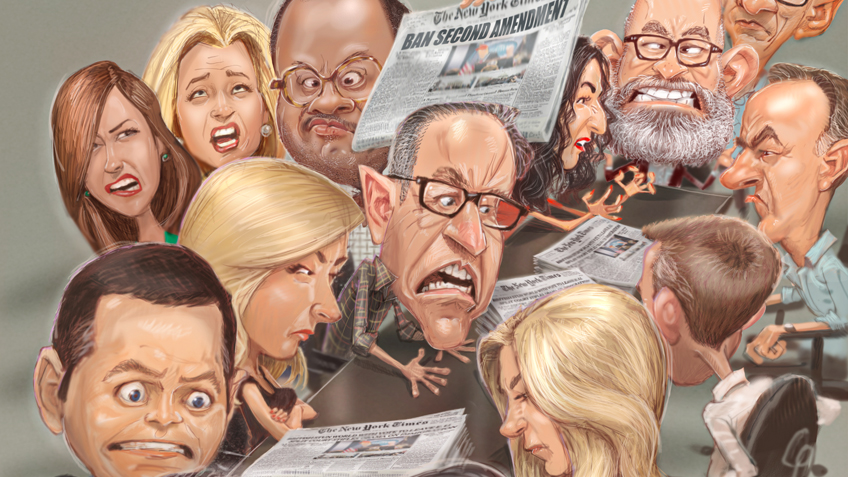
In a sadly predictable plot twist, The New York Times’ Editorial Board’s activists turned on their own to drive out a few voices who still dared, ever so carefully mind you, to follow their intellectual honesty away from the politically correct orthodoxy of the far left.
Neither James Bennet, now former editorial page editor of The New York Times, nor Bari Weiss, now former op-ed staff editor for The Times, were ousted for publishing honest opinion pieces about guns—can you even imagine that? What happened to them is, nevertheless, a telling example of how anything honest pertaining to Second Amendment rights, or about how to actually make America even safer, is increasingly being discouraged, shunned and outright banned from coverage by the mainstream media—and by many in Hollywood and by those running the major social-media companies.
The “cancel culture” they are leading is a cancer within the left that has stymied rational conversation between people who happen to have different views. Unsurprisingly, this thought cancer is now attacking its host. The far left, in fact, now thinks that merely speaking to a person with a pro-freedom perspective is corrupting—an idea cultivated and spread by humanities departments in elite academic institutions.
As this was being written, Bret Stephens, an opinion columnist for The New York Times who came from The Wall Street Journal in 2017, is considered to be the last “moderate” writing for The Times’ opinion section. But this isn’t even so when it comes to the Second Amendment, as soon after joining The Times, Stephens wrote a column titled “Repeal the Second Amendment,” as if to let his new colleagues know he is willing to sell out even the fundamental basis of liberty to make it in the mainstream media. He began the column with the line: “I have never understood the conservative fetish for the Second Amendment.”
Perhaps it could be said that Stephens should read a little more American history, and that he should get out into America just a little bit to see and feel the liberty he wants to extinguish, but that misses the point. Stephens may or may not know all of that; regardless, he is weakly selling out for a check and for false status in the hierarchy of a dishonest newspaper.
The Times, meanwhile, is still a flagship leading the left. It is read by politicians, by the media elite and by academics. What it publishes—and doesn’t publish—affects many of the narratives the mainstream media adheres to with blinding, fingers-in-their-ears banality.
This includes issues related to guns.
John Lott’s experience with The Times is a clarifying example. Lott, the founder and CEO of the Crime Prevention Research Center and the author of More Guns, Less Crime and other books, is forever trying to get his research to every audience. This has made him a glutton for progressive punishment. In 2018, he pitched The Times an opinion piece on how background checks disproportionately deny gun purchases to law-abiding minorities.
“The fact-checking and editing lasted three months, with dozens of emails back and forth. One Times employee wrote me: ‘Sorry they made you jump through fiery hoops…,’” says Lott.
Incredibly, Lott got his opinion piece into the pages of The Times; well, it was more a shadow of his article than the actual thing, as they “watered it down into meaninglessness,” says Lott.
After it ran, one Times staffer emailed Lott: “Everytown [the anti-gun group launched by Mike Bloomberg] and others, have let us know how displeased they are that we ran your piece.” Another Times employee confided in Lott that they had received 75,000 “angry” emails the day after his article ran. Lott soon heard that gun-control groups had organized email and telephone campaigns to pressure The Times into firing the staff who were involved in running his opinion piece.
The next Sunday, The Times tried to quell the criticism by running an editorial calling Lott a “disreputable economist best known for misusing statistics to suit his own ideological ends.”
“In my case, the orchestrated outrage by gun-control organizations probably had its desired effect. It will be a long time, if ever, before The New York Times publishes another of my opinion pieces,” says Lott.
Lott explains that “unfortunately, this is a pattern I have seen over and over again at different news outlets; for example, after an organized backlash a couple years ago, The Hill will no longer run my pieces. After publishing 33 of my op-ed submissions without a single refusal, The Hill has since rejected the next 103 pieces, many of which were subsequently published in reputable publications.”
One member of The Hill’s staff privately told Lott that the owner just didn’t want to deal with all of the anger generated by activists regarding his columns. Lott says that editors at places from the Los Angeles Times to the Chicago Tribune have told him similar stories about them being pressured into not running pro-Second Amendment content. Cancel culture, especially when it comes to the truth about guns, is resulting in a lot of censorship.
Bari Weiss, the former staff editor and writer for The Times opinion section, published a public letter on why she had to leave what she loudly characterizes as a toxic work environment. She said she experienced “constant bullying by colleagues who disagree with my views” and an environment where she said “self-censorship has become the norm.”
“What rules that remain at The Times are applied with extreme selectivity,” she wrote in a lengthy resignation letter, which she posted to her personal website. “If a person’s ideology is in keeping with the new orthodoxy, they and their work remain unscrutinized. Everyone else lives in fear of the digital thunderdome. Online venom is excused so long as it is directed at the proper targets.”
Publications like The New York Times claim to defend classical liberal values, but today, free speech only applies in their pages to speech they like. Anything honest related to guns in America, according to them, just isn’t news that’s fit to print.
Most Popular