Photo courtesy of the NSSF
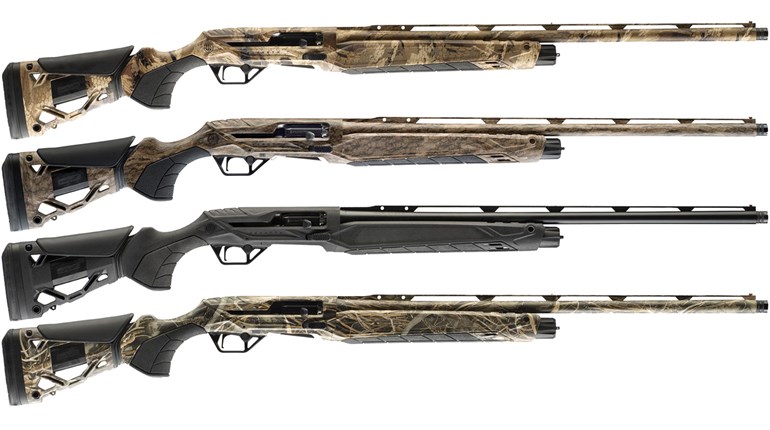
If you can handle the recoil and shoot a 12-gauge shotgun well, then there’s little reason to go with a smaller gauge for self-defense; after all, when your life’s on the line, the more lead delivered to your attacker is almost always better; anyone who tells you a 20-gauge is just as good as a 12-gauge or a 28-gauge is just as good as a 20-gauge is not speaking from a mathematical, terminal-performance perspective, but a personal one.
Indeed, the mighty 12-gauge has become so standard that anything smaller is often referred to as “sub-gauge.” Still, this doesn’t mean sub-gauge guns don’t have a couple advantages: Namely smaller-gauge guns are typically made on slighter frames and are therefore lighter, easier to hold and wield with all else being equal. Of course, when it comes to shotguns and gauges, few things are equal.
Gauge is an old British measurement for the diameter of a gun’s bore. Technically, it’s a count of the number of pure lead balls, of a given bore diameter, that add up to equal a pound. Twelve lead balls of .729-inch diameter equal a pound. Therefore, a shotgun with a bore diameter of .729 diameter is called 12-gauge. (Some vary slightly depending on choke and manufacturer, but this is the standard size.)
12-gauge = .729 of an inch
16- gauge. = .662 of an inch
20-gauge. = .615 of an inch
28-gauge. =.550 of an inch
.410 bore = .410 of an inch (This cartridge was made in America and was named for its bore’s diameter in inches.)
Besides its gauge, a shotgun’s performance also depends on the load chosen. For the purpose of this article, we’ll stick to common, commercially available payload weights for the various gauges. Payload weight influences the shell’s terminal energy (how much energy it delivers to the target) as well as greatly influencing recoil.
12-gauge = 11/8 oz.-11/4-oz.
16-gauge = 1 oz.-1 1/8 oz.
20-gauge = 7/8 oz.-1 oz.
28-gauge = ½ oz.-¾ oz.
.410-bore = ½ oz.-11/16th oz.
The second advantage of a sub-gauge shotgun is gained by its inherently lighter payloads, and therefore (but not necessarily) its reduced recoil. Recoil is a big deal.
Because sub-gauge guns also weigh less, recoil reduction is not as pronounced as many people believe; for example, if you shoot an ultralight 20-gauge with a heavy load, you could actually receive more recoil than from a heavier 12-gauge gun. In other words, if you want the lightest recoiling gun possible, shoot the lightest load in the heaviest gun possible; however, an ideal gun and sub-gauge load for self defense is likely somewhere in the middle.
Shotgun energy and terminal performance is also complicated by many variables. Consider a 00 Buckshot pellet from a 12-gauge shotgun that leaves the muzzle at 1,200 feet per second. Mathematically, that individual pellet produces the exact same energy as a 00 buck pellet going the same speed fired from a .410. The difference is, the .410-bore might only send 5 pellets to the target, whereas the 12-gauge might fire up to 15. Collectively, the 15 pellets from the 12-gauge delivers much more energy to the target compared to the .410. But it also has twice the recoil.
While 16- and 28-gauge loads are not widely available and can be more expensive, the .410-bore is interesting. If you can find a reliable pump, semi-auto or even a good double-barrel .410 that’s easy to wield, this gauge offers tremendous recoil relief compared to a 12 or even a 20. And while it is half as powerful as the average 12-gauge, consider that a modern 5-pellet 00 Buckshot load still produces more than double the energy of a .45 ACP pistol round.
In sum, if you are a person of adult strength and dexterity who practices proper shooting fundamentals, a 12-gauge is superior for the majority of scenarios. Any quality pump or semi-automatic with a relatively short barrel will do nicely for home defense. But if you prefer a lighter gun that you can handle better along with less recoil, go with an average-weight 20-gauge and an average 00 Buckshot load. Whatever shotgun you choose, make sure it’s clean, reliable and you know how to use it even when the lights go out and the chips are down.
Most Popular