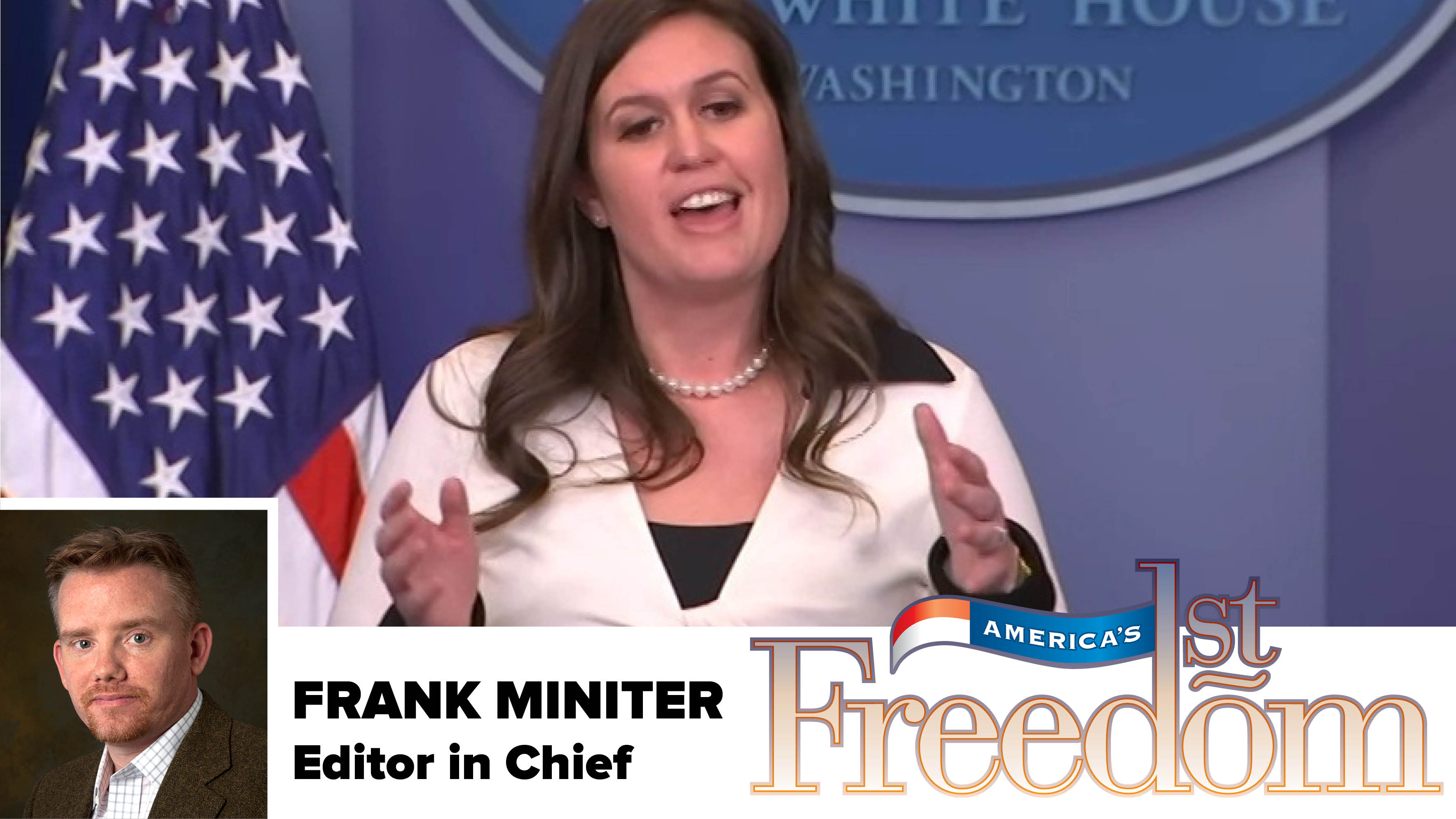
On Sept. 12, former White House press secretary Sarah Huckabee Sanders tweeted: “Democrats say we have guns in America because of ‘corruption’. No, we have guns because it’s our God-given right enshrined in the Constitution.”
The tweet went viral and drew reactions from Americans who know a lot about their freedom and from those who know little or nothing. Some of these later comments mocked Sanders’ mention of God.
“Oh, was God at the signing of the Constitution…?” wrote one.
Many responded by saying that yes, indeed He was.
One troll, who uses an image of one of the small people from the original movie “Willy Wonka & the Chocolate Factory” (1971) as his or her picture, mocked Sanders’ allusion to God by writing: “You don’t remember ‘And He sayeth unto Thomas and George, ‘Carry thine holy musket forth and improveth upon it so that it mayeth slay many enemies in a matter of a minute. But stayeth away from lawn darts, as they are deadly and a sin in mine eyes.’”?
Funny, but really just an attempt to keep the conversation from exposing the ignorance of those criticizing Sanders.
At a time when gun-control is being talked about by many in Congress and by Democratic presidential candidates, more people clearly need to learn more about the nature of their rights.
Thomas Jefferson actually asked in 1782: “Can the liberties of a nation be thought secure when we have removed their only firm basis, a conviction in the minds of the people that these liberties are of the gift of God?”
Really though, this debate needn’t become religious as we all have the freedom to practice the faith we are called to or to practice none at all. Regardless of this individual decision, we all have the same fundamental rights, as Sanders says, “enshrined in the Constitution.”
The U.S. Bill of Rights is erected upon the fundamental belief that we have a body of other rights, natural rights we inherently have until someone else takes them away. In the Declaration of Independence, Thomas Jefferson said natural rights were granted to us by “the Creator.” Others believe they are philosophical rights that developed in nature.
Some today, however, deny that natural rights even exist. They don’t want to acknowledge there is a deeper philosophical, or perhaps theological, foundation for our rights, because such rights have long acted as a moral check on government.
This debate is, however, very American.
During the U.S. Constitutional period, in the Federalist Papers (no. 84), Alexander Hamilton asked, “Why declare that things shall not be done which there is no power to do?”
Hamilton thought a Bill of Rights would be superfluous because the federal government was then thought to be restricted to the powers it is granted in the Constitution. Other politicians, however, mainly the Anti-Federalists, such as Patrick Henry and George Mason, saw the need for a bill of rights to spell out an additional list of limitations on the federal government to prevent a centralized bureaucracy from exceeding its constitutional limitations.
So yes, from the beginning, there was a debate about whether a Bill of Rights should be included in the Constitution.
The Founders had read thinkers like John Locke (1632-1704), who defined natural rights as “life, liberty and estate [property].” And Thomas Hobbes (1588-1679), who, in Leviathan (1651), said natural rights extend from the “state of nature.” Hobbes thus argued that man has the essential human right “to use his own power, as he will himself, for the preservation of his own Nature; that is to say, of his own Life….”
The idea that we have the natural right to preserve “our own nature” underlies our rights to self-defense, to protect our own property, to speak the truth as we see it and so on.
Sanders is exactly right. Unfortunately, today’s educational system rarely teaches these fundamental underpinnings of our freedom.
(Frank Miniter’s latest book is The Ultimate Man’s Survival Guide to the Workplace.)
Most Popular